Archival Grandfather Testament Volume

Al-Jāmiʿ – The Record

A guided Islamic legacy journal for fathers and elders, created to preserve family stories, faith, values and written testimony for future generations.

£438

Series I - Limited to 500 Numbered Volumes

What This Volume Is

A structured legacy record where a father writes his life, his values, and his message for those who come after him.

It guides him to document:

  • where he came from
  • what he believed
  • how he lived
  • what he learned
  • and what he leaves behind

Thirteen carefully constructed sections lead him through his life - from early years and faith to family, hardship, lessons, and final words.

Each page is designed so he does not need to “figure out what to say,” but can write clearly and completely.

The result is not fragments or memories scattered across time, but a single written record - kept, read, and inherited by his children and grandchildren.

How It Is Constructed New

The volume is organised into thirteen sections that follow the natural arc of a life.

Each section contains guided prompts written in the voice of those who will one day read it - his children and their children.

Moments of pause, reflection, and duʿāʾ are placed throughout the volume, allowing the writing to move with intention rather than haste.

The structure is deliberate - so that nothing essential is left unsaid.

For Whom It Is Written

This edition is written for the father, and for the grandfather he will become.

For the man whose life carries memory, responsibility, and belief - but whose words may otherwise remain unrecorded.

Within Islamic tradition, what is written carries weight. Testimony, counsel, and remembrance are not left to chance.

This volume exists so that his life is not reduced to memory alone.

It exists so that his words may remain.

Each volume is bound to order and issued under allocation protocol.

This book is not his biography. It is his duʿāʾ.

The Making of

The Record

Every volume passes through four stages of formation. Each stage is chosen for permanence, not display. Each stage is governed by archival durability standards.

Paper Selection
STEP I

Paper Selection

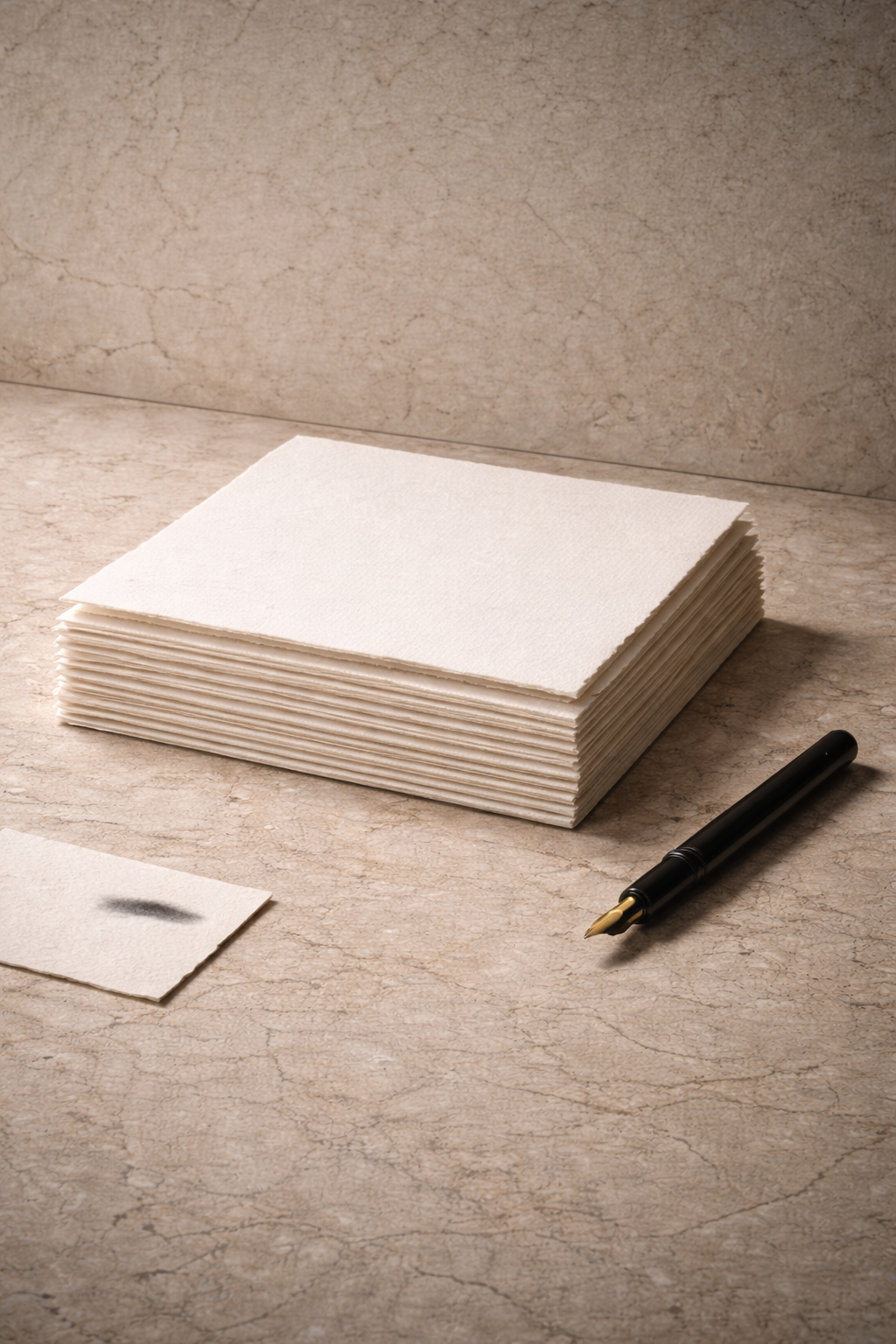
Each sheet is selected for permanence before appearance. The Record is printed on archival-grade, acid-free stock with a neutral pH and a weight chosen to resist bleed, warp, and long-term fatigue. Grain direction is aligned to preserve stability through decades of handling and annotation. This is not lifestyle paper. It is a writing substrate designed to endure pressure, time, and custody.


Stitching
STEP II

Stitching

The text block is assembled in gathered signatures and sewn to distribute tension across the spine. This method allows the volume to open fully without strain, reducing cracking and separation over time. Stitching is selected not for nostalgia, but for mechanical reliability - a structure that survives repeated use. The spine is formed to remain functional long after the first owner.

Leather Casing
STEP III

Leather Casing

The completed text block is encased in full-grain leather, selected for fibre strength and density rather than surface gloss. Boards are set for rigidity without excess mass, and the spine is shaped to accommodate expansion as the volume lives and is handled. The casing is built to protect the work inside it - not to perform for a shelf.

Gilding
STEP IV

Gilding

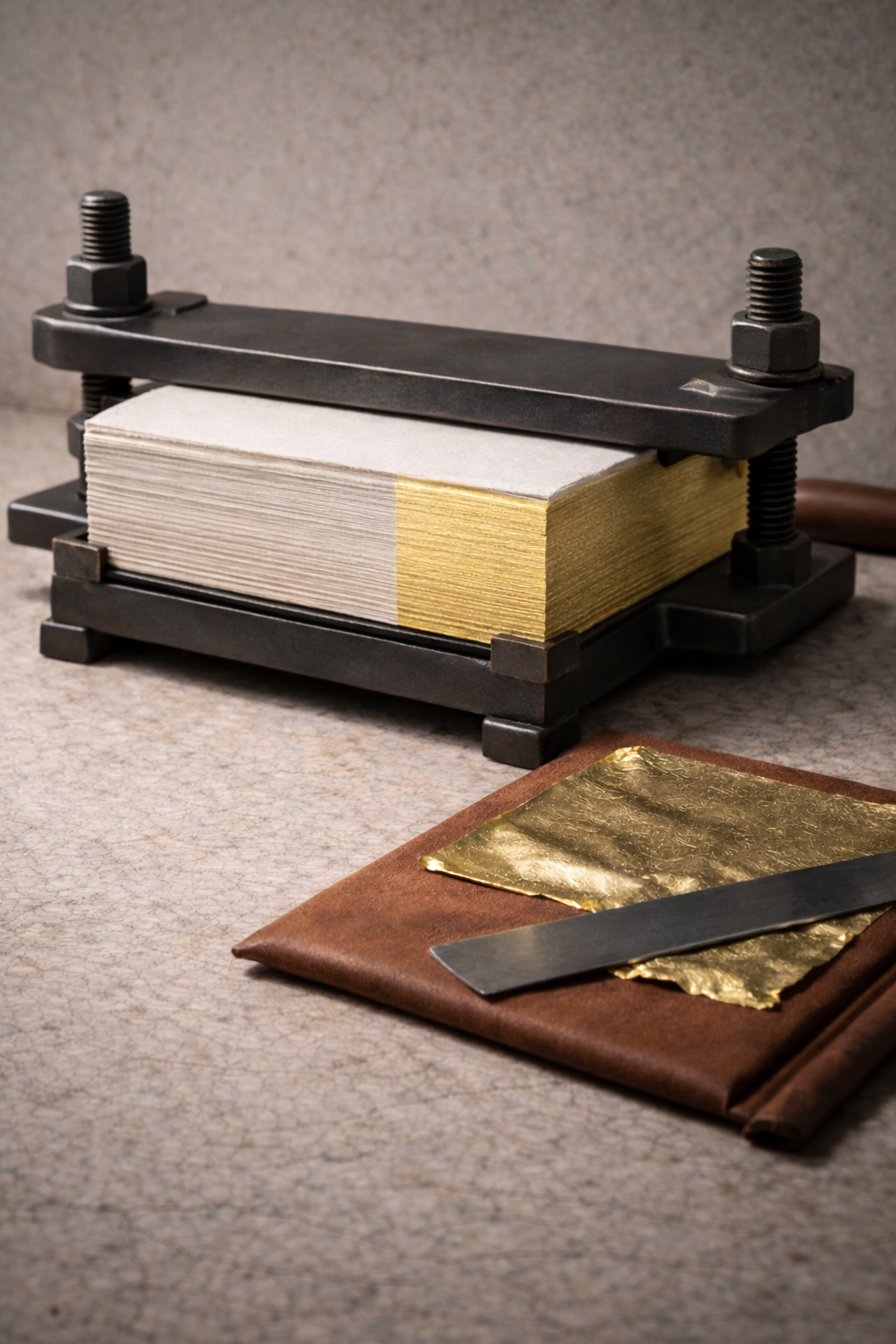
The edges are gilt to protect the archive. Gold-leaf gilding is not ornament. It is a barrier - reducing moisture ingress, dust intrusion, and edge-wear across years of storage and handling. The finish is applied to preserve the page block’s integrity and to keep the volume clean under repeated contact. Applied to preserve structural integrity over extended generational use.

The Record Is Written Once.

It is not replaced.
It is held.
It is returned.
It is inherited.

Edition Notes

The Record is a privately issued heirloom volume created for the deliberate preservation of personal and familial history.

It is not a notebook in the commercial sense. It is a structured legacy manuscript - designed to be written once, retained, and passed forward.

The Record is guided.

Its pages contain carefully composed prompts that lead the writer through memory, faith, lineage, and reflection. These prompts are structured to preserve coherence across generations while leaving space for the individual voice.

It is not prescriptive - but it is intentional.

A standard journal records the present moment.

The Record is composed for inheritance.

Its structure, materials, and editioning are designed with generational continuity in mind. From paper stock to binding, from numbering to presentation, it is produced as a permanent object rather than a disposable volume.

The distinction lies in purpose.

The Record is intended for those who wish to formalise their legacy.

It may be written by a father, or grandfather who understands that memory, once lost, is rarely recovered intact.

Its ultimate audience is not the writer - but those who inherit it.

Each volume forms part of a finite and documented release.

Individual numbering establishes provenance. It identifies the volume's position within a closed series and ensures that no additional copies may be introduced into that edition.

The limitation is structural, not promotional.

No additional volumes will be produced under the same edition mark.

Future iterations, should they exist, will belong to separate series with their own numbering and historical context. No volume may be retrospectively inserted into an earlier run.

Its place within the edition is fixed.

Its record, once written, is singular.